How One Nonprofit Found $350,000+ in Projected Healthcare Savings
August 7th, 2026
SHRM-Atlanta
Rising healthcare costs often force employers into a difficult choice: absorb a major premium increase or reduce the value of the benefits offered to employees.
For one national nonprofit, neither option was acceptable.
The organization, which has approximately 80 employees and 40 employees enrolled in its medical plan, was approaching an April 1, 2026 renewal with an above-market increase. Leadership needed to control costs while protecting the employee experience - and they needed to make a decision quickly.
Through AHRIA, SHRM-Atlanta's benefits solution, the organization partnered with McGriff, a Marsh McLennan Agency Company, to review its existing coverage, evaluate the market and model new plan options. The result was more than $350,000 in total projected savings over a multi-year period compared with the organization's previous renewal trajectory.
Just as importantly, the proposed options maintained or improved benefits for employees.
The Challenge: Lower Costs Without Reducing the Value of Benefits
The nonprofit's leadership wanted more than a less expensive insurance quote. It needed a benefits strategy that could:
- Objectively evaluate the renewal and uncover meaningful savings opportunities
- Compare alternatives using clear data and actuarial analysis
- Maintain or improve the employee healthcare experience
- Minimize disruption during implementation
- Provide ongoing support for medical, dental, vision, life and disability benefits
With a February 1 decision deadline, the organization also needed a partner capable of moving quickly while completing a thorough analysis.
A Comprehensive Review of the Benefits Program
McGriff assembled a consulting team with expertise in actuarial analysis, underwriting, pharmacy, technology and client service. Rather than evaluating the medical plan in isolation, the team reviewed the organization's broader benefits strategy and developed several paths forward.
Evaluating the Carrier Market
The team compared the incumbent renewal with alternatives using a national PPO network. Multiple plan designs were modeled, including different deductible levels and HSA-compatible options, so leadership could see clear, side-by-side cost and coverage comparisons.
Exploring a Co-Pay Elimination Strategy
McGriff also introduced a co-pay elimination program designed to work alongside a fully insured medical plan. The program restructures how eligible routine claims are funded, allowing employees to pay $0 in co-pays for services such as primary care, specialist visits, urgent care and covered pharmacy tiers.
This gave leadership the opportunity to consider more than premium savings alone. The organization could also choose a plan designed to reduce common out-of-pocket costs for employees.
Preserving Ancillary Benefits
To avoid unnecessary disruption, McGriff recommended transferring the existing dental, vision, life and disability plans through a Broker of Record arrangement. This allowed the organization to preserve those plan designs and employee relationships while bringing the benefits program under one service team.
Two Options, Both Better Than the Renewal Path
After completing the analysis, McGriff presented two options for the April 2026 renewal.
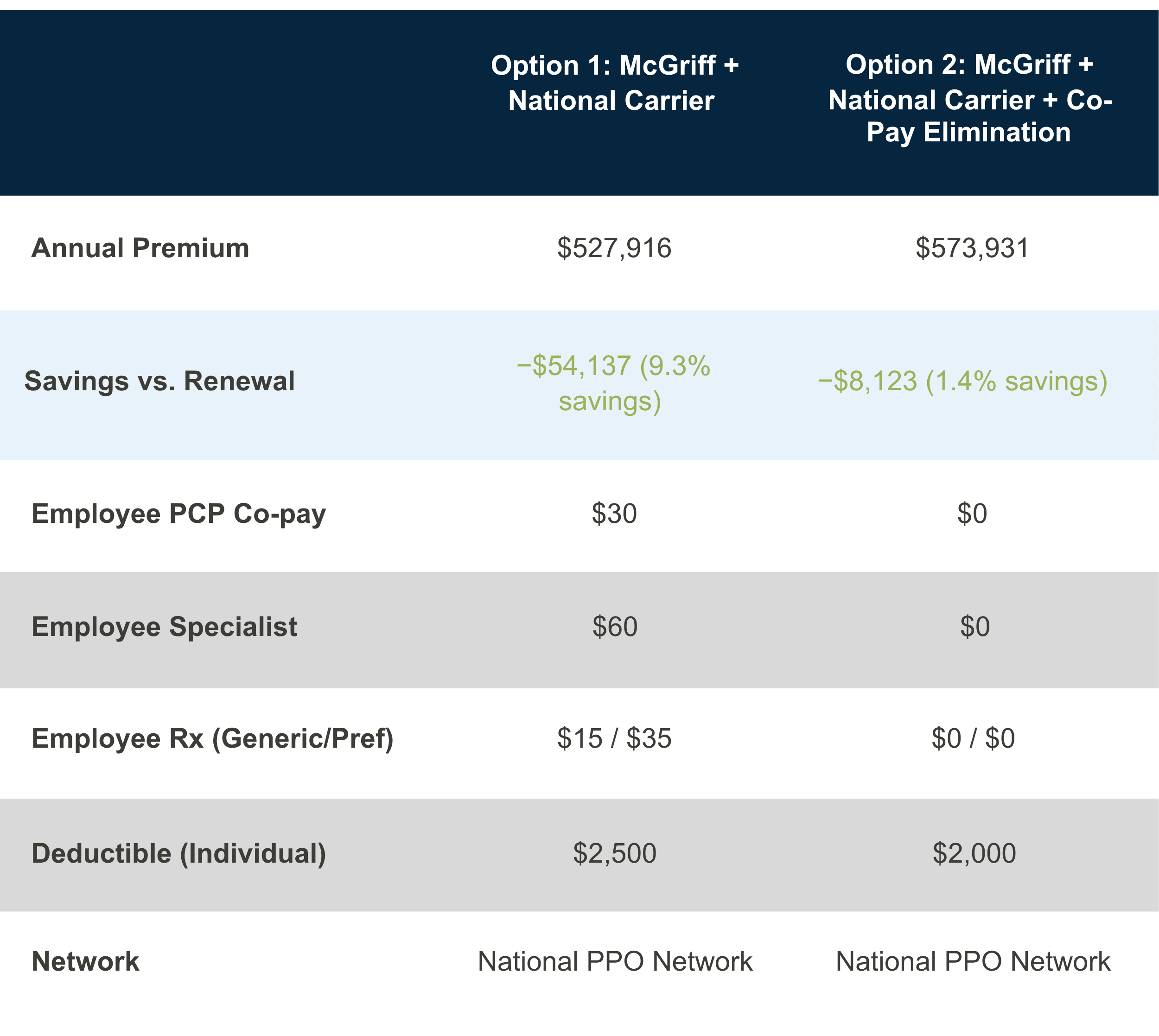
Option 1 prioritized immediate premium relief. It reduced annual premiums by $54,137, or 9.3%, while offering a richer plan design than the organization's previous coverage.
Option 2 produced a smaller premium reduction of $8,123, or 1.4%, but eliminated employee co-pays for several of the most commonly used healthcare services. For an employer focused on recruitment, retention and employee financial well-being, that added value could be a meaningful differentiator.
Both options provided access to a national PPO network, giving participating employees access to providers across all 50 states.
The Results at a Glance
The analysis gave the nonprofit more control over a difficult renewal and produced measurable opportunities for both the organization and its employees:
- More than $350,000 in total projected multi-year savings compared with the previous renewal trajectory
- Up to $54,137 in annual premium savings under Option 1
- The opportunity for $0 employee co-pays on primary care, specialist visits, urgent care and covered pharmacy tiers under Option 2
- Access to a national PPO network across all 50 states
- Continued dental, vision, life and disability plan designs with minimal employee disruption
- A single benefits team supporting analysis, implementation, communication and ongoing service
The case demonstrates that reducing benefits costs does not always require employers to increase deductibles, raise co-pays or scale back coverage. With the right analysis, market access and plan design, employers may be able to improve both financial performance and the employee experience.
What Other Employers Can Learn From This Case
Every organization has different employees, claims experience and business priorities. Still, this case offers several useful lessons for employers approaching a challenging renewal.
Start the review early. More time creates more room to evaluate carriers, model plan designs and communicate changes effectively.
Look beyond the renewal percentage. Premium cost matters, but deductibles, co-pays, pharmacy expenses, network access and administrative demands also affect the true value of a plan.
Ask for multiple strategies. A strong advisor should be able to present meaningful choices, including options that prioritize employer savings and options that improve employees' out-of-pocket experience.
Consider the full benefits program. Medical coverage is only one part of the employee experience. Preserving continuity across dental, vision, life and disability plans can make a transition much smoother.
See What a Fresh Benefits Analysis Could Find
AHRIA gives SHRM-Atlanta members access to employee benefits expertise through McGriff, a Marsh McLennan Agency Company. Members can request a complimentary benefits analysis that reviews current plans, evaluates potential savings and presents tailored options with no obligation.
If your organization is preparing for renewal or looking for a more strategic approach to employee benefits, now may be the right time for a second look.
This case study reflects the experience of one organization. Savings are projected, and results may vary based on an employer's plan design, demographics, claims experience, market conditions and other factors.